
The data center market worldwide is entering a period of faster growth driven by cloud adoption, artificial intelligence (AI), and machine learning (ML). The market is anticipated to rise to over $1 trillion in 2034, upwards of what it is today (about 386.7 billion), and the market in the United States is predicted to reach almost $309 billion by 2030. Although data centers today use only 2-3 percent of the world’s electricity, this figure is expected to rise to 10% by 2030, placing an unprecedented burden on energy production, distribution, and infrastructure.
By 2030, U.S. data centers are expected to use as much as 35 gigawatts of electricity, which is twice the amount they used in 2022. Hyperscale facilities (AI and quantum computing) and advanced analytics may require 20-100+ MW per site, whereas smaller centers (cloud services and storage) require 1-5 MW. The operations of servers take up a dominant portion (50-70) of energy consumption, followed closely by cooling systems, networking equipment, and backup power infrastructure. The estimated grid investment utilities project is over 580 billion over the next 10 years, while the American Society of Civil Engineers estimates the country needs 3.7 trillion to enable future energy transmission.
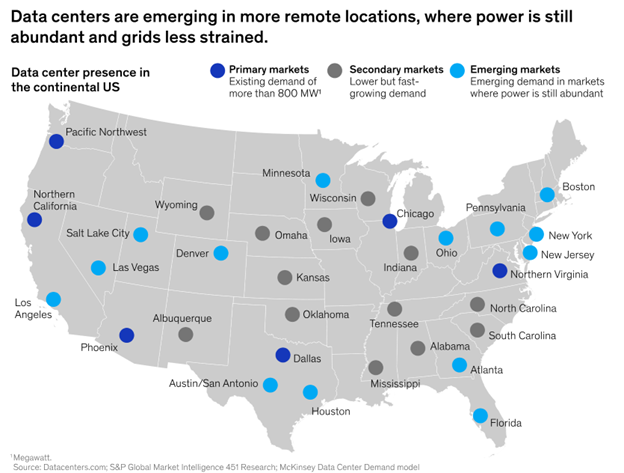
There are more than 4,100 data centers in the U.S., with Northern Virginia, Texas, California, Illinois, and Ohio as the top markets. Northern Virginia remains the hub of global internet traffic and is expected to add more than 9 GW of new capacity by 2030. Texas, Georgia, Arizona, and the Midwest have remained the destinations for hyperscale and colocation development because of low costs, faster permitting, available land, and easy access to power. Red states in particular are pairing economic development incentives with streamlined regulatory environments, to accelerate growth.
Policy and legislative activity around data centers intensified significantly in 2025. Lawmakers across all 50 states introduced 238 data center-related bills addressing energy consumption, grid stability, water use, zoning, and tax incentives. Energy policy dominated, with multiple states exploring nuclear and microgrid solutions to support large loads. At the same time, states reassessed tax incentives, with some expanding exemptions and others tightening eligibility requirements.
Shepherd Strategies names a few of its “rising star” states to invest in data centers, such as Indiana, Kentucky, Mississippi, Nevada, Ohio, Pennsylvania, and West Virginia. Long-term tax breaks, utility alignment, grid expansion plans, and pro-development regulatory structures are provided by these states. The federal involvement is also picking up the pace as the Department of Energy has launched a solicitation to build AI data centers on federal land within Kentucky, as well as on the grounds of other federal labs.
At the federal level, the Trump Administration has prioritized AI, quantum computing, and grid resilience through executive orders aimed at accelerating permitting, opening federal lands, and streamlining environmental reviews. Programs such as FAST-41, the Speed to Power Initiative, and expanded federal leasing authority are reducing development timelines while aligning workforce, energy, and infrastructure funding.
For Shepherd clients, the opportunity spans development, construction, energy, and financing. Success will depend on early regulatory positioning, access to power, government readiness (SAM.gov and compliance), strategic partnerships, and a focus on flexible site-shell development rather than one-size-fits-all facilities. Non-dilutive capital through grants, tax incentives, and public-private partnerships will be critical to maximizing margins in this rapidly expanding market.
To understand how these policy shifts and funding programs impact your business, connect with Shepherd Strategies. We provide data-driven advisory, government market intelligence, and capital strategy to help you move forward with confidence.


© 2026 Shepherd Strategies LLC.
All Rights Reserved.